






Employee-Centric End-to-End Transaction Monitoring

Unified transaction logging across systems for faster troubleshooting and stronger audit control.

Designed and implemented a central Employee Transaction Logging Framework that captures every employee action in a consistent, searchable log.

About The client

Client Under NDA

This project created a single source of truth for employee and system transactions by standardising how events are logged across processes, automations, and integrations.

The framework maps actions back to the relevant employee record, making it easier for operational teams to understand what happened, when it happened, and where it originated.

It also supports audit and compliance needs by preserving an accurate employee-linked action history that can be reviewed through reports and dashboards.

Know More

How It Went

The Challenge

The focus was to reduce admin effort, minimise data errors, and improve audit readiness by ensuring all impacted records remain aligned whenever a termination plan changes.

  • Transaction logs were scattered across multiple systems and functions, with inconsistent formats and missing traceability.
  • Teams could not easily reconstruct what happened during an employee or system transaction because there was no unified audit source.
  • Different logging approaches created visibility gaps, increasing manual effort for support and operations teams.
  • Recurring incidents and compliance risk required a rapid, reliable monitoring framework to improve confidence in system behaviour.
Know More

How We Did it?

Our Solution

We implemented a structured, employee-linked logging model designed to be usable by HR, supervisors, and compliance teams without relying on ad-hoc investigation.

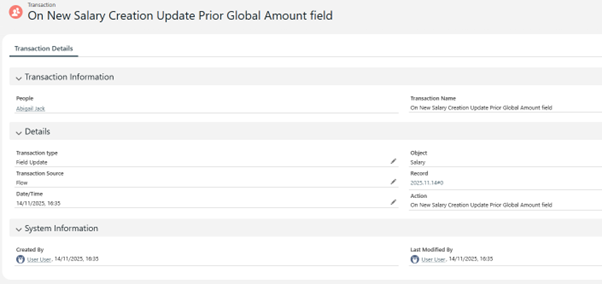
  • Step 1: Central transaction log object – Created a dedicated Employee Transaction Log Object as the single source of truth, with key fields to record each action against the corresponding employee.
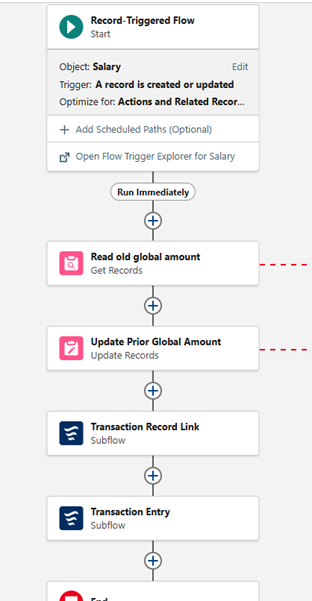
  • Step 2: Standardised logging schema – Introduced a consistent set of fields and formats so every transaction is captured uniformly, whether triggered by Flows, Apex, integrations, or user actions.
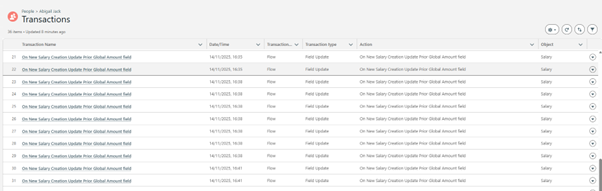
  • Step 3: Monitoring via dashboards and reports – Configured actionable reports and dashboards so teams can track employee actions in near real time and resolve issues faster using log insights.
  • Step 4: Built for scale – Designed the framework to be modular and reusable, allowing new processes and automations to adopt the logging model with minimal effort.

This approach supported measurable operational improvements including >99.5% payroll accuracy, 30-40% faster HR review and approvals, and a 50% reduction in audit preparation time.

Get Started With Your Project

Technologies & Platforms

  • Salesforce - Lightning App Builder
  • Salesforce - Reports and Dashboards
  • Salesforce - Flows
  • Salesforce APIs (REST/SOAP)

Joint Effort

The Collaboration

We worked closely with operational stakeholders to define what needed to be captured, how it should be structured, and which views would support day-to-day usage.

The delivery focused on repeatable patterns: a standard logging model, clear ownership of data fields, and dashboard/report views that answer the most common investigation questions quickly.

The result was a framework that can be extended as new HR processes and automations are introduced, without redesigning the underlying logging approach.

Work With Us

The Result

Project Outcomes

  • Achieved >99.5% payroll accuracy by logging every payroll-impacting change with clear employee attribution.
  • Reduced HR review and approval turnaround time by 30-40% through consistent and transparent transaction tracking.
  • Cut audit preparation time by 50% with instant audit trails and complete employee action history.
  • Improved accountability across onboarding, transfers and exits by 20-25% through traceable employee-linked actions.
  • Faster troubleshooting through a single, searchable transaction log for cross-system events.
  • Greater data confidence for HR and compliance teams through standardised logging and reporting.
Get Started With Your Project

Project Screenshots

FAQ's

About This Project

An employee audit trail is a chronological record of actions and changes linked to an employee, showing what changed, who or what triggered it, and when it occurred.
You define a standard logging schema and capture events into a central log object that becomes the single source of truth, then surface it through reports and dashboards.
At minimum: employee reference, timestamp, action type, source system/process, triggering user or automation, key field changes, and an identifier to correlate related steps in a transaction.
It removes guesswork by providing a consistent event history, allowing teams to trace the sequence of steps, pinpoint failures, and validate system behaviour faster.
Dashboards turn log data into operational views, helping teams spot issues, review exceptions, and produce audit evidence without manual data gathering.
By using a modular logging framework and reusable patterns so each new automation or integration adopts the same schema and reporting views.

Got more questions? Feel free to reach out to us for more details & also get a free consulting session with our experts.

Get More Details

Talk To Our Experts

Need Help?Talk To Our Experts